
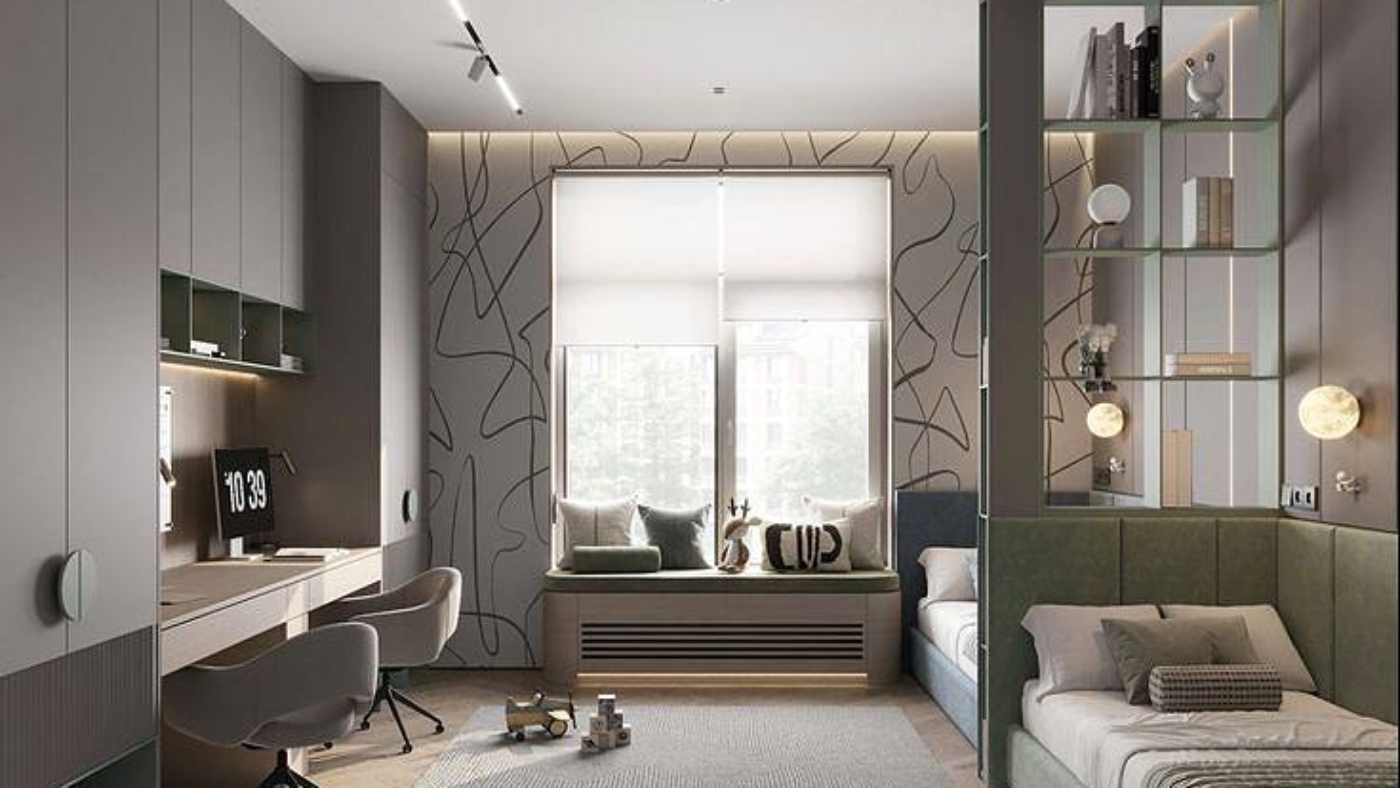
Designing an apartment for a family requires a fundamentally different logic than standard residential planning. Architect Raúl Llorente emphasizes that a children’s zone cannot be treated as an isolated function – it must be integrated into the overall architectural structure of the home and account for the evolving dynamics of family life. At RentSale RealEstate, we apply this principle already at the property selection stage, evaluating not only the current characteristics of an apartment but also its capacity to adapt over time.
The first level of analysis focuses on spatial structure and zoning. A children’s zone must maintain a careful balance between privacy and connection to shared areas. Excessive isolation complicates supervision and interaction, while a lack of clear boundaries reduces a child’s sense of security. We analyze internal circulation patterns and identify how family interaction naturally forms within the apartment.
The next critical element is proportion and geometry. A children’s room must provide sufficient depth and width to accommodate sleeping, storage and activity zones simultaneously. We assess whether the space allows transformation without loss of functionality – for example, evolving from a play-focused environment into a study-oriented zone without requiring full-scale reconstruction. This adaptability becomes a decisive factor in long-term suitability.
Natural light receives particular attention. Daylight has a direct impact on circadian rhythms, concentration and emotional well-being. We evaluate window orientation, room depth and daily light distribution to determine whether the space remains comfortable without constant reliance on artificial lighting.
Acoustics and spatial relationships between zones are equally important. A children’s area must be protected from noise generated by kitchens and living rooms while remaining connected to family life. Architectural solutions – such as the positioning of walls, doorways and buffer spaces – make it possible to achieve this balance without visual isolation.
We also treat flexibility as a strategic parameter. The ability to reconfigure space – shifting functions, adapting for a second child or integrating a workspace – significantly increases a property’s long-term value. At RentSale RealEstate, we evaluate whether such changes can be implemented without complex or costly interventions.
The building context completes the architectural assessment. Safe common areas, elevators, intuitive navigation, logical building entrances and well-developed infrastructure directly influence daily family experience. Even a well-designed apartment loses value if the building itself does not support a family-oriented lifestyle.
As a result, architectural design of a children’s zone is not a decorative task but a long-term planning tool. At RentSale RealEstate approach residential space as a living system that must support a family through different life stages while maintaining comfort, functionality and market relevance.
Earlier we wrote about duplex apartments in Barcelona – when the format truly works and how RentSale RealEstate evaluates their potential